

Pastor's Corner
Entering Magdalen Through Ancient Magdala
Jesus “went about all Galilee, teaching in their synagogues and preaching the gospel of
the kingdom” (Mt 4:23). Surely the synagogue at Magdala is among those
places—perhaps even where Jesus first met Mary Magdalene. In 2009, while preparing
land for a visitors center, archaeologists uncovered the synagogue at Magdala. It is the
oldest known synagogue in Galilee, dating from the time of Jesus.
One of the most striking discoveries there is an ornately carved stone, now called the
Magdala Stone. Filled with imagery drawn from the Jerusalem Temple, it sat in the
center of the synagogue. Many scholars believe it served as a kind of podium for a
teacher seated on the floor. It is likely that Jesus Himself taught before it.
Early synagogues functioned mainly as libraries or reading rooms, but over time they
came to be treated as sacred spaces. The detailed carvings on the Magdala Stone
likely signaled that by reading and praying the Scriptures, the community was entering
into the mystery of God—much as someone did at the Temple in Jerusalem.
Among the carvings is a six-petaled rosette, the same symbol that decorated the veil
separating the Holy of Holies. That same rosette now marks the plaza in front of our
church. It reminds us of our connection with ancient Magdala and, even more, that
when we enter this church, we step into the presence of God. As the synagogue was
seen as an extension of the Temple, so this place is an extension of the eternal Temple
of heaven.
Fr. David Marstall, Pastor
A Season of Waiting
We aren’t very good at waiting. At least I’m not. And compared with people in the past,
most of us struggle with it. Modern technology has conditioned us to expect everything
instantly. A few weeks ago, while driving back to Wichita, I asked my phone what time a
business closed. The connection was poor, and it took nearly two minutes to get the
answer. What an inconvenience! Of course twenty years ago, it wouldn’t have taken two
minutes—I simply wouldn’t have known until I arrived.
The internet and social media, streaming services providing entertainment on demand,
and online retailers that let us finish Christmas shopping without leaving the couch—all
these conveniences shape us to expect immediate results. Even before the internet,
sitcoms quietly taught us that life’s problems should resolve neatly within thirty minutes.
But relationships don’t work that way. Certainly our relationship with God doesn’t.
Relationships take time, patience, and commitment. They require us to accept that
things won’t always go the way we want or happen according to our preferred schedule.
A deep relationship with God means turning to Him day after day, not knowing whether
prayer will be full of grace or marked by dryness and waiting. The Lord simply asks us
to show up, to give Him our time, and to trust that He knows what we need in each
moment.
The season of Advent teaches us again that the Lord is coming. As truly as He came
2,000 years ago, He will come again in glory to judge the living and the dead. And He
comes even now—sometimes subtly, sometimes profoundly—into the hearts of those
who wait for Him with faith.
My brothers and sisters, let us wait for the Lord with holy, patient, and eager expectation
Fr. David Marstall, Pastor
Stewardship of Treasure
This weekend, I’m asking everyone to make a financial pledge for the coming year. Of course,
we give not simply because the parish needs funds, but because giving itself is good for the soul.
Generosity shapes us into grateful disciples. We support our parish not only when everything
goes our way, but because it is our spiritual home.
At the same time, you have a right to know how your gifts will be used. I realize that I don’t yet
have a track record here, and we’re still working with a budget that was completed before I
arrived. So I want to share with you three Scripture passages that guide the way I think about
money—both personally and in parish administration.
Genesis 41 – Pharaoh’s Dream:
Joseph interprets Pharaoh’s dream to mean that seven years of abundance will be followed by
seven years of famine. In times of plenty, Egypt prepared for leaner times. Magdalen is currently
blessed with abundance, but that won’t always be the case. We must plan ahead—for future
repairs, possible economic downturns, or even times of trial in the Church.
Luke 13:6–9 – The Barren Fig Tree:
Even in abundance, there is no room for waste. If a ministry is not bearing fruit—if it’s not
helping people grow closer to God—we first work to renew it. But if it still bears no fruit, we
must redirect our resources toward what truly advances our mission.
Matthew 13:45–46 – The Pearl of Great Price:
It’s never a waste to spend everything on the Kingdom of God. When something truly draws
people to Christ, it deserves our full support. Jesus calls us to be “all in” for what matters most:
to seek first the Kingdom of God and trust Him with the rest.
Fr. David Marstall, Pastor
Who Are All These Priests?
Sunday, November 9, 2025
Here at Magdalen, we have a wonderful “problem”: more people want to attend daily Mass and receive the Sacrament of Reconciliation than two priests can accommodate!
When we had three priests on staff, we were blessed with more flexibility—and we’d like to continue offering that same level of care. To keep three weekday Masses and Sunday Reconciliation available, we’ve welcomed the help of several other priests who now assist us on a regular basis.
Fr. David Lies – 7:00 a.m. Mass on Tuesdays and Wednesdays
Fr. Lies serves as the Vicar for Clergy, representing the bishop in caring for and guiding the priests and deacons of our diocese. He resides at the Priests’ Retirement Center and spends his time at the chancery or on the road visiting priests, especially those facing illness or other challenges.
Fr. Mike Nolan – 5:30 p.m. Mass on Thursdays
Fr. Nolan is a retired priest of our diocese and most recently served as chaplain at McConnell Air Force Base. Many parishioners may know him from his role in diocesan training for Extraordinary Ministers of Holy Communion.
Fr. Ken Schuckman – 5:30 p.m. Mass on Fridays
Fr. Schuckman is the newest diocesan retiree, having most recently served as chaplain at Ascension Via Christi St. Joseph.
Capuchin Franciscan Friars – Reconciliation during the 11:30 a.m. Mass on Sundays
We’re also blessed to welcome three Capuchin Franciscan Friars—Frs. Donald Rank, Sales Pathrose, and Charles Polifka, OFM Cap.—who will take turns hearing confessions on Sundays. The Capuchins recently opened a house in Wichita for the formation of young friars who have completed their novitiate. We’ll be giving them more opportunities to be visible in the future—but for now, you can find them in the box!
Please express your gratitude to these priests whenever you have the chance.
Fr. David Marstall, Pastor
Pope Leo Writes on Love for the Poor
Sunday, October 19, 2025
Pope Leo Writes on Love for the Poor
Pope Leo XIV recently released his first apostolic exhortation, Dilexi te. An apostolic exhortation is an encouragement to the faithful to live out a particular part of the Church’s teaching in a bolder way. The title Dilexi te quotes Revelation 3:9 where the Lord says, “I have loved you”—words addressed to a Christian community with little wealth or power.
Pope Francis began writing this exhortation before he died. Francis was well known for his love for the poor and continued solidarity with the poor even as pontiff. Pope Leo XIV is a brilliant economist and theologian who lived a missionary life among the poor of Peru. What a gift to have Francis’ heart clarified and expressed by Leo!
After recounting the teaching in Scripture regarding God’s love for the poor and the insistence on this teaching throughout Church history, especially in the writings of the Saints, in chapter four he recounts some keys aspects of the Church’s social doctrine, formulated especially over the past 150 years beginning with Pope Leo XIII’s encyclical Rerum Novarum. That encyclical was written in response to changing economic conditions due to the industrial revolution. Leo XIV has said he chose the name Leo because he sees the world going through a similar transition now due to artificial intelligence and other technological advances. He hopes to do for the Church in this age what Leo XIII did in his.
Pope Leo XIV mentions a few themes which will likely be the center of his teaching in the coming years. Improving the social system requires providing opportunities for work and truly valuing the work others provide. Human dignity requires not just that people be provided with food, clothing, and shelter, but with the opportunity to participate fully in the social system—thus the rising inequality and separation between the rich and poor is to be worked against. Love for the poor requires not only a fair social system, but a change of heart that sees all others as our equals.
I encourage everyone to read his exhortation at: APOSTOLIC EXHORTATION DILEXI TE OF THE HOLY FATHER LEO XIV TO ALL CHRISTIANS ON LOVE FOR THE POOR
Fr. David Marstall, Pastor
Make it Personal
Sunday, October 12, 2025
Make it Personal
A personal relationship with Jesus should be just that—personal.
We see in the Gospels that Jesus often spoke to large crowds. It is worth spending time imagining the Lord with thousands in front of Him on the hillsides in Galilee. So many people heard Him speak, received His teaching, and went home with something to ponder for the rest of their lives.
But that is not discipleship. The disciples also heard the sermons and witnessed the miracles that the crows saw, but then they had a special opportunity. We see it in the Gospels that after the crowds went home, when the disciples were alone with Jesus, they had a chance to ask their questions and have a little back and forth with Jesus. (See for example, Mark 4:10-20) What an awesome opportunity that must have been!
Those first disciples had the greatest preacher ever, but even after listening to Jesus they had questions. The Lord gave them the chance to ask those questions, to discuss things together, and let the Gospel become more personal.
As a preacher, I want what I say to lead people closer to Jesus. That is why I normally end in prayer. I also try to give people an invitation to apply my words to their own lives. But really, our lives are pretty different. More importantly, the Holy Spirit calls each of us to respond to the Lord in a unique way. For that reason, a conversation with others serious about growing in the Lord can be really powerful.
With the opening of the Adult Discipleship Center, we now have the opportunity to allow disciples to gather after Mass and go deeper into the Liturgy of the Word and help each other to make it personal. Several weeks ago a group of young adults began gathering after the 9:30 Mass. We have a group of empty nesters who will begin in a few weeks. We give them some targeted reflection questions to challenge and encourage each other. I would love to see other groups of adults (young adults, older adults) getting together after each weekend Mass to enjoy some coffee and fellowship and to help each other grow as disciples of the Lord.
If you are interested in joining, either as a participant or facilitator, please email our Director of Parish Evangelization and Discipleship Amanda Prieto, This email address is being protected from spambots. You need JavaScript enabled to view it. and we will put more groups together.
St. Mary Magdalen, Apostle to the Apostles, pray for us.
Fr. David Marstall, Pastor
Is There Something Missing?
Sunday, Aug. 24, 2025
Is There Something Missing?
It is a common experience for students graduating from Catholic high school and going to state universities that their first year causes a great interruption in their relationship with God. For years they were in an environment that encouraged and helped them to deepen their faith, learn more, and practice what they have learned. Of course, there are certain temptations that can go along with college life, but even without falling into these, many will find there is something missing. But it does not impact everyone the same.
Each of us tends to be attracted to God according to one or two of His qualities—His unity, His truth, His goodness, His beauty. These four qualities of God appeal to the deep desires in the human heart, but differently for different people. Some are excited by his beauty and so are moved greatly by the music at Mass, marvel at the beauty of a sunset, and can easily be taken up by a great piece of religious artwork. Some are struck by God’s goodness and so their relationship with God is nourished more by the example of the Saints or by acts of kindness received and even those shown to others. Some marvel at the unity, the oneness of God, so integrating their knowledge and their actions together becomes very important. Some are moved by the truth of God, so the things they learn about God are what nourish their faith more than anything else.
For “God’s truth” people, it is essential to be learning about God. It doesn’t necessarily matter what. They could be learning about a sacrament they are preparing for, how to grow in their marriage, reading about Christology, or going through a random book of the Bible. For these people, the loss of learning through their religion classes creates a vacuum that needs to be filled for them to continue growing.
There are many adults who try hard to practice the faith. They attend Mass, put their kids in Catholic school, help out around the parish, but are not growing. Their excitement and devotion dim over time. Is that you?
We are good at insisting that our children be learning the faith, but it is just as important (maybe even more) for adults. As we start the school year, I encourage all of our adults to find a faith formation opportunity. Those offerings will be highlighted in the bulletin and at Mass over the next few weeks, but don’t worry if you can’t find exactly the right thing for you. Often it is good enough to just have something.
Fr. David Marstall, Pastor
Choose to Give Him More
Sunday, Aug. 17, 2025
Choose To Give Him More
“Father, I think I’ve learned more here than in 12 years in Catholic school.” I’ve heard this said many times in classes I taught or retreats I’ve led. I’ve heard it said by college students and adults. I’ve heard it said when people came back from programs or conferences that I didn’t lead, with frustration (“Why didn’t anyone teach me this before?”) and with joy (“I’m so excited about what is happening now!”). It is a common experience that people who with many years of religious education all of a sudden have an experience that seems greater than everything else combined. What is behind this experience?
While there may be many reasons, one of the most important is the role of choice. In school, students are put in a class according to their age, and that class is given something to learn (the curriculum). There is of course some time for random questions, opportunities for students to pick the topic of a research paper, and good teachers try to make the course responsive to the needs of the students, for the most part students study what the curriculum dictates, so they do so somewhat begrudgingly.
I point this out for two reasons. For students, if you are aware of this dynamic, you can choose your response. You can see class as something you have to get through, or you can choose to really be formed by it. Here at the beginning of the school year, make a choice. You can say to yourself and to God, “I didn’t pick this class, but now I choose it. I choose to learn about ____ so I can grow in my relationship with You.” God always respects your freedom, so He will only take the parts of your mind and heart that you give Him. Choose to give Him more.
For adults, you are invited now to classes and Bibles studies to allow your own faith to be better formed. You may have had the experience that religion classes in school were not all that enjoyable or impactful, and you may presume that adult classes will be the same. That would be false. Even if we taught the same course with the same teacher and the same books, the mere fact that it begins with you making an adult decision to grow in your faith, that you picked one group rather than another, that you are choosing to spend time growing your faith rather than the many other things you could be doing, actually does give God the room to do more in a few weeks than you allowed Him to do in twelve years. Make the choice.
Fr. David Marstall, Pastor
A Day of Gratitude
Sunday, July 27, 2025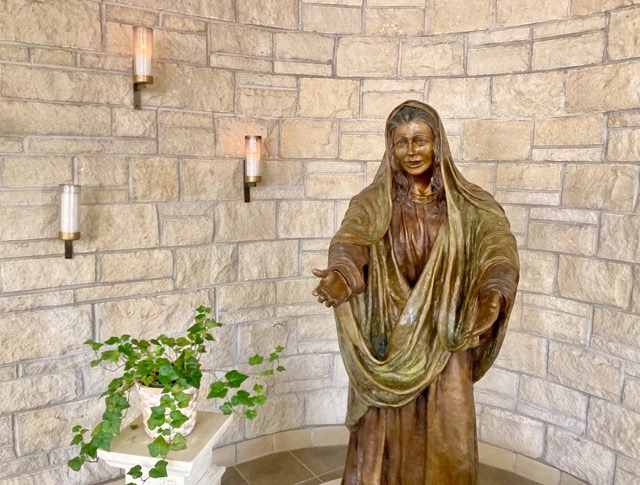
As we celebrate our patroness this weekend, we rightly reflect on the many gifts and blessings this parish has received through her intercession. This is true every year, but especially this year as we celebrate the 75th anniversary of our founding. Since 1950, the people of our parish have been graced through the prayers of St. Mary Magdalen.
I would invite each of you to take count of some of the blessings you have received. Perhaps this is where you learned about God, where your marriage began, where you or your children were baptized. For many, this community provided comfort at a time of loss or struggle. Perhaps you have experienced powerful moments of mercy in the sacrament of reconciliation or consolation in prayer before our Blessed Lord. I hope that everyone can say this parish contains people you can rely on as good friends who accompany you through life—providing encouragement or even a challenge to help you to grow. Even those like myself who are very new have already begun to receive grace, though perhaps these things go unnoticed.
It is easy for us to take these things for granted or to forget about them when life is hectic. In one sense, maybe it is good that we don’t always think of them—that just means they are reliable and we can count on them being there. Maybe there are extraordinary moments when we are surprised by the mercy of God or the goodness of his people. Most of the time, however, we just find it normal. We aren’t amazed to walk into a clean church or think about the generosity of those who cleaned it. We aren’t surprised by a beautiful liturgy or think about the dedication of those who prepared for it. We aren’t astonished when we are served well in the office or when our children receive a top-notch Catholic education, and we don’t give much thought to the devotion of those who make those things possible. We aren’t surprised any more than a child is surprised when dinner is ready, because those people are dependable.
Today is a day to notice and give thanks. Take a moment to notice those things and even make ourselves aware that behind each of those works is a loving God inspiring the hearts of His faithful in response to the prayers of St. Mary Magdalen.
Fr. David Marstall, Pastor
Thank You & St. Mary Magdalen
Sunday, July 20, 2025
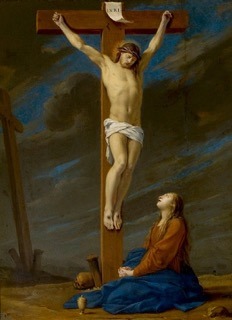
Thank you! What a great welcome I have received here at the Church of the Magdalen. Changing parishes is one of the hardest things a priest experiences personally, but people here have made my experience much better than I deserve. I am grateful to Fr. Jirak for preparing so well for this transition. I am grateful to the staff for their patience as I learn how things are done here. I am grateful to those who prepared the receptions my first weekend, those who have shown me little things, introduced themselves, greeted me with kindness, and invited me to their homes. I am grateful.
Fr. David Marstall, Pastor
My Last Pastor's Corner
Sunday, June 22, 2025
May the Lord give you peace!
This is my last Pastor’s Corner. I don’t know how many I’ve written—but it’s been a lot! Surprisingly, I’ve enjoyed writing these reflections. I’m grateful that you’ve taken the time to read them, whether they were good or not-so-good. :)
On my first weekend at Magdalen, during the first week of Lent in 2018, I introduced what we called the “Adoration Drive,” which quickly became known as “300.” I hadn’t planned to begin my time at Magdalen that way, but the Holy Spirit moved my mind and heart so strongly that I had to follow the Divine impulse. I was also surprised by how well it was received—nearly 200 people signed up for a weekly Holy Hour that very weekend. It was a clear confirmation that the Holy Spirit was alive and ready to burn at Magdalen. That flame led us to update the Magdalen logo with a flame rising from the roof. Some people commented that it made the church look like it was on fire. I responded, “Exactly!”
Now, I leave Magdalen seven and a half years later on the cusp of the opening of the Discipleship Center. The vision for this Center, conceived five years ago, was to become a school for adults. It’s exciting to watch its progress. Many people have told me they’re sad that I won’t be here for the grand opening, which is scheduled for the end of August. Honestly, I’m not sad. I’m excited—for you. Truly. The Discipleship Center is the manifestation of a dream: a dedicated space where adult parishioners of Magdalen can take their discipleship to the next level and become missionary disciples.
I can honestly say that I poured everything I had into these 7.5 years as your pastor. I know I wasn’t perfect, and I sincerely apologize to anyone I may have hurt along the way. I gave you my best, and I’m incredibly grateful that you let me serve you. This assignment has been, for me, the “abundant life” Jesus promised (Jn. 10:10). As I leave, don’t forget: “Magdalen Next Level”, and always “Better Together.”
Ad majorem Dei gloriam,
Fr. John F. Jirak, Pastor
Campaign and Legacy Giving
Sunday, June 15, 2025
May the Lord give you peace!
Next weekend we will conclude the Diocesan Capital Campaign, One Family, Fully Alive in Christ! Bishop Kemme initiated this campaign to benefit both the Diocese as a whole and each parish individually. Twenty percent of the financial gifts return directly to the parish to support an approved local project. At Magdalen, we discerned to designate this portion toward building a portico at the south church entrance and expanding our Adoration Chapel.
Reaching our $4.1 million goal would fully fund both projects. If we fall short, Fr. David and parish leadership will discern the best path forward. This may involve prioritizing one project over the other or waiting until we receive sufficient bequest contributions to move ahead with both.
This brings me to an important initiative I’ll be handing off to Fr. David. We have recently reconstituted the Magdalen Legacy Society, which aims to cultivate financial gifts through bequests. I’m convinced that legacy giving will play a vital role in Magdalen’s future. Over the past three years, we’ve participated in three major campaigns: Kapaun Mt. Carmel, our Magdalen parish Capital Campaign, and the Diocesan Capital Campaign. Understandably, many have expressed a sense of campaign fatigue. There’s only one sustainable way to avoid future campaigns: legacy giving.
Legacy giving is a true final act of stewardship, activated at the moment of death. While it’s not easy to talk about death, it is a meaningful step that helps us rightly order our values and goals. Discerning a legacy gift is a beautiful and selfless way to prepare for a holy death. Even my dad, a rural Kansas farmer, was moved to include a bequest in his will. He and my mom have five children, and they decided to make the Church their “sixth child” in their will. That decision deeply inspired me and I share their example with many.
Ad majorem Dei gloriam,
Fr. John F. Jirak, Pastor
Saying Goodbye
Sunday, May 25, 2025
May the Lord give you peace!
As you know, I will be leaving Magdalen as Pastor at the end of June. Honestly, the only thing I don’t like about being a priest is having to say goodbye. This will be my fourth time leaving a parish: I served as parochial vicar at Blessed Sacrament for 2 years, and at the Cathedral for 3 years. As pastor, I served at Blessed Sacrament for 7.5 years, and now at Magdalen for the same.
It’s never easy to leave. However, one thing that leaving has taught me is that this life is passing. St. Thomas Aquinas states that our trials make us aware of the transitory nature of this world. A letter written to Diognetus in the 1st or 2nd Century highlights the transitory character of the Christian life, stating, “There is something extraordinary about their [Christians’] lives. They live in their own countries as though they were only passing through. They play their full role as citizens, but labor under all the disabilities of aliens. Any county can be their homeland, but for them their homeland, wherever it may be, is a foreign country.” In other words, we are all pilgrims on this earth.
In recent weeks, I’ve experienced moments of sadness and even dejection. Yet those have been accompanied by deep consolation and gratitude to God for the incredible 7.5 years we've shared. We’ve been through much together. Your passion for the Catholic faith has inspired me often, and I am genuinely excited about Magdalen’s future. Stay Next-Level!
Ad majorem Dei gloriam,
Fr. John F. Jirak, Pastor
Discipleship, Pope Leo & the Discipleship Center
Sunday, May 18, 2025
May the Lord give you peace! Wow, it’s been an exciting week with the election of a new Pope and, more than that, an American Pope: Pope Leo XIV. I am still getting used to saying his name during the Eucharistic Prayer at Mass. Once, I almost said Pope Francis XIV. :)
In his first homily as Pope, the Holy Father explicitly mentioned discipleship—and not just any discipleship, discipleship with the cross. He stated, “When we walk without the cross, when we build without the cross, and when we profess Christ without the cross, we are not disciples of the Lord.” He continued that even if one is a bishop, priest, or cardinal, even a Pope, without the cross, one is not a disciple.
Discipleship follows Christ by “walking,” “building,” “professing,” and carrying the cross. This is difficult and enduring work and can only be successfully lived out with other disciples. Discipleship only grows with others through charity. For this reason, we need spiritual friends to encourage, support, counsel, and even at times to correct us with fraternal life. In his first homily Pope Leo stated that we are a “community of friends of Jesus.” I love it! I’m so grateful that we have all sacrificed to create a space where the adults of our parish can walk, build, and profess while carrying our crosses together as friends of Jesus. The Discipleship Center has been designed to be a place for our adults to grow together in spiritual friendship and discipleship. It is our “school” for developing adult disciples.
Ad majorem Dei gloriam,
Fr. John F. Jirak, Pastor
Pope Francis and Mercy
Sunday, Apr. 27, 2025
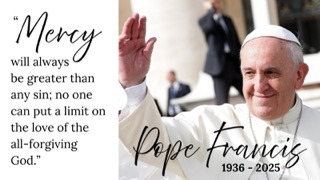
May the Lord give you peace! Alleluia, Alleluia! Yesterday morning I received a text that Pope Francis had died. I wasn’t shocked, yet somehow I was shocked. When a Pope dies, even though it’s not a surprise due to the circumstances of health and age, the gravity and importance of the Papacy for the Catholic faith leave us in a state of bewilderment and flux. Well, at least that is my experience.
I don’t see the timing of the Pope’s death and this Sunday’s celebration of Divine Mercy Sunday as accidental. I see Kairos—that is, God’s timing. In other words, Divine Providence. As we celebrate Divine Mercy Sunday, we also say goodbye to the Pope of Mercy. Pope Francis was about mercy from the first moment of his election in 2013. In fact, he chose as his papal motto Miserando atque eligendo: “having been shown mercy and chosen.” The motto comes from the Gospel of Matthew, where Matthew is chosen as an Apostle while still sitting at the tax collector’s table. The exact phrase is lifted from a passage by St. Bede on the calling of St. Matthew. A more familiar expression of this moment hangs as one of Caravaggio’s most famous paintings in the church of San Luis dei Francesi. Fr. Marco will likely be visiting the church to see the painting this week in Rome.
Pope Francis experienced this mercy in a powerful way at sixteen years of age when he felt a Divine impulse to enter a church and make a good confession. He encountered the Lord’s forgiveness during that confession in a way that would wrap around him as a permanent garment for the rest of his life. Pope Francis’ mother urged him not to become a priest; she preferred that he become a doctor. The future Pope responded that he would study the “medicine of the soul.” And what is the medicine of the soul? Pope Francis knew intimately that this medicine is the merciful gaze of his Lord. The salient theme of his pontificate was applying the anointing of mercy. In my humble opinion, the papacy of Pope Francis will be misconstrued and misinterpreted if studied apart from the framework of mercy.
Mercy is certainly God’s forgiveness first and foremost. However, mercy is also God's help, as none of us earns His help outright. We need this help always and everywhere. When we live with this awareness and attitude, we are never far from the merciful gaze of our Lord. St. Mary Magdalen knew this gaze, and Pope Francis knew it too. May this gaze warm our own drowsy hearts and clear our clouded minds on this Divine Mercy Sunday.
Ad majorem Dei gloriam,
Fr. John F. Jirak, Pastor
Recognizing The Risen Lord Within You
Sunday, Apr. 20, 2025
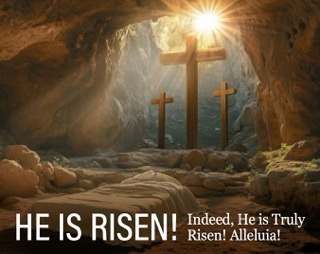
He is Risen! Indeed, He is Risen! This Easter Sunday greeting originates from the earliest centuries of Christianity. The greeting is also sometimes referred to as the “Paschal Greeting.” To say that Christ is risen is to say that he is alive. He is living. And, he is living now among us and within us in 2025. Recognizing his resurrected presence is always an act of faith. Even for those privileged individuals who saw the resurrected Lord before the Ascension, an act of faith was required.
The risen Lord is within us. Where is he? How do I recognize him? The risen Lord is working within us to raise us from sin to grace, from being an enemy of God to being a friend of God, even to being an intimate of the Lord. An important place to recognize his presence is in the growth and development of our interior life as His disciples. The risen Lord always begins where we are and there are no shortcuts. The stages of rising in the Christian tradition are generally referred to as the Purgative way, the Illuminative way, and the Unitive way. We can recognize his presence within the stage that we find ourselves in our relationship with the Lord. Without grace, we can’t take one step toward God. The natural can’t leap to the supernatural without the aid of the supernatural. It is the Lord who always takes the initiative as the Catechism of the Catholic Church teaches us. We participate by responding to the Lord’s initiative.
By recognizing the stage that we are in, we recognize the presence of the risen Lord, as we are not allowed entry into any stage without Him. So, which stage am I in? St. Thomas Aquinas offers some helpful descriptors associated with each stage. He describes characteristic actions that a person performs proper to each stage. This doesn’t mean that the person doesn’t perform actions proper to other stages; rather, generally speaking, the described behaviors are what’s taking most of the person’s attention and effort. Here are the three stages in which the risen Lord is at work within each of us and their characteristic activities:
1. The Purgative Way, or Way of Beginners
- Actions pertaining to avoiding sin (bad habits)
- Resisting sinful inclinations
2. The Illuminative Way, or Way of the Proficient
- Behaviors pertaining to guarding oneself from sin
- Behavior pertaining to growing in virtue (good habits)
3. The Unitive Way, or Way of the Perfect
- Actions pertaining to dwelling with God and experiencing enjoyment in God
As you reflect upon these stages in order to recognize the presence of the risen Lord within, don’t look at it too black and white. These are general sketches and there are nuances and exceptions. However, I have found it a very helpful guide for myself and guiding others. He is risen! Indeed, He is risen!
Ad majorem Dei gloriam,
Fr. John F. Jirak, Pastor
Prayer and Fasting Cast Out Evil
Sunday, Mar. 23, 2025
May the Lord give you peace! As many of you have heard, a so-called “Black Mass” is being planned for 11am on Friday, March 28 outside of the Kansas Capitol building in Topeka. This is a grave concern as it is a desecration of the most sacred of the sacred, namely, the Most Precious Eucharist. The organizers of this event claim to have a Consecrated Host.
What are we to do? In a letter to the faithful, Bishop Kemme has asked—actually implores us—to “join me in responding to this grave situation with fervent prayer and fasting.” I know some parishioners are planning to pray at the site where the desecration is taking place. That is beautiful and inspirational. Bishop Kemme will be leading a Holy Hour of Reparation at our Cathedral at 11am followed by the usual noon Mass. He is also recommending for all adults a voluntary Lenten day of fasting, such as we offer on Ash Wednesday and Good Friday. Prayer and fasting are powerful spiritual exercises that everyone can practice. I am reminded of the occasion when the Apostles were sent out to heal and cast out evil spirits. They returned and confessed to the Lord, “Why could we not cast it out?” He responded, “This kind can come out by nothing but prayer and fasting” (Mark 9:29).
When it comes to prayer, there is no more powerful prayer than the Mass. In the Diary of St. Faustina, Jesus told her that one day he was going to cause a chastisement to fall on the city of Warsaw for their many sins. He then instructed Faustina to “unite yourself closely to Me during the sacrifice and offer My Blood and Wounds to My Father in expiation for the sins of that city.” Faustina followed through, uniting herself to Jesus and offering His Body and Blood to the Father as an expiation for their sins, which resulted in the Lord blessing “the entire country” (Diary, 39).
Along with the Bishop’s request, I would encourage us all to follow the same directions that the Lord gave to St. Faustina on the occasion when he was ready to destroy the city, namely, at the next Mass you attend:
1. Through your intention and choice, unite yourself to Jesus at Mass. This can be as simple as the prayer, “Jesus, I join myself to you at this Mass.”
2. Offer Jesus’s Body and Blood to the Father. We are actually directed to this offering when the priest says, “Pray, brothers and sisters, that my sacrifice and yours may be acceptable to God, the Almighty Father.”
3. Make the intention of the offering the cancellation of the so-called Black Mass and for the healing and conversion of all involved. Did you know that the priest offers the Mass for a specific intention at Mass? These are called Mass intentions or offerings. However, each participant can also choose to offer the Mass attended for a specific need.
These three steps are not just a great formula to prepare the mind and will to pray the Mass well for a specific intention. They are the formula by which we reap the greatest fruit from the Mass, and in which we participate fully, consciously, and actively as directed in paragraph 14 of the Second Vatican Council’s document Sacrosanctum Concilium.
Ad majorem Dei gloriam,
Fr. John F. Jirak, Pastor
Prepare for a Next-Level Lent
Sunday, Feb. 23, 2025
May the Lord give you peace!
Lent is just around the corner, and this is the perfect time to plan for living Lent well—or as I like to say, "Next Level." Sadly, I have experienced a number of disappointing Lents due to overlooking or forgetting the importance of planning. It simply is not possible to live Lent well without some intentionality and planning before it begins. This year, I am happy to announce a unique Lenten Challenge for adult parishioners. Like any good challenge, it is not too easy and not too hard. And, as with any good challenge, there is a reward or prize associated with it.
This year’s Next-Level Challenge is to complete at least 5 of the 6 weeks of one of the following options:
- Sign up and complete a weekly Holy Hour in the Adoration chapel.
To participate in this option, you must sign up for an hour in the Adoration chapel. If you already have an hour, you must sign up for a second hour for the six weeks of Lent to complete the challenge.
- Attend one daily Mass each week.
To participate in this option, you must select a daily Mass that you are not already attending. In other words, if you attend daily Mass four days a week, then you will need to attend a fifth Mass.
- Attend the Sunday morning Adult Catechism Class.
Catechism class will be held each Sunday from 8:30-9:20am in the Fr. Kapaun Room. Terra Reusser will be teaching from the Catechism’s section on Life in Christ, which covers Catholic morality.
Of course, there must be a reward. I am excited about the prize for completing the challenge. Winners will receive a free ticket to a Mexican fiesta dinner with the priests after Easter. Fr. Marco will be exhibiting his famous salsa. When he made this salsa at the rectory, I was in my bedroom and my eyes were actually burning. You won’t want to miss it.
I hope that you will join our Next Level Lenten Challenge.
Ad majorem Dei gloriam,
Fr. John F. Jirak, Pastor
World Marriage Sunday
Sunday, Feb. 9, 2025
May the Lord give you peace!
This weekend we celebrate World Marriage Sunday. Let’s spend a few moments reflecting on the good of married life. I call marriage a gift as it comes from God, and it is good. In fact, the recognition that “its not good for the man to be alone” led to the creation of woman and to the Adam’s elated response, yes, “this one at last, is bone of my bone, this one is flesh of my flesh” (Genesis 2:23).
Marriage is a natural good. As a good it contributes to human happiness and flourishing. Theologically and canonically, we know that the two goods of marriage are the flourishing of the spouses and the bringing forth and raising up of children. It is absolutely necessary for us to keep these two goods in mind as marriage will always be compromised when these two goods are not given their full due reverence and appreciation.
Between two Christians, we also recognize a third good: a supernatural good. The union between a man and woman becomes a sacrament. In the sacrament of marriage the two are made one in God so that now their relationship has a new goal and new purpose, namely, that through marriage the couple are called to holiness, to accompany one another to become saints.
When the grace of the sacrament elevates the natural union of man and woman in marriage, no harm is done to the natural goods of marriage. Human happiness realized in the good of the spouses sharing life and love together and the joy of children remains. Not only is no harm done to the natural goods of marriage, but they are enhanced and elevated by the good of the sacrament, the grace of marriage. The sacrament inclines the spouses to love each other and to love their children out of love for God the Father.
A wife can love her husband for the husband’s sake, and this is both beautiful and deep. But, taking it to the next level, the wife can love her husband for God’s sake, namely, motivated by her love for God. This Divine love inclines the wife to go beyond what is due to her husband. With promptness, her elevated love is ready to be everything that St. Paul described in his letter to the Corinthians, Chapter 13. In 1 Corinthians 13:4-7, Paul describes love with the following qualities.
- Love is patient
- Love is kind
- It does not envy
- It does not boast
- It is not proud
- It does not dishonor others
- It is not self-seeking
- It is not easily angered
- It keeps no record of wrongs
- Love does not delight in evil but rejoices with the truth
- It always protects, always trusts, always hopes, always perseveres
Does this sound difficult? Yes, it is very difficult. Yet, it is very attractive. How do I know? Well, this reading is chosen more than any other reading for wedding Masses. Yes, it is attractive and seen as “very good” to those couples preparing for marriage. This leads me to believe that there is a strong desire for the sacrament of marriage, i.e., the elevation of natural marriage. God doesn’t merely desire that there be natural happiness in marriage. Rather, God sent his Son that married couples might have life, and, have it more abundantly” (John 10:10).
Ad majorem Dei gloriam,
Fr. John F. Jirak, Pastor
Building and Building
Sunday, Feb. 2, 2025
May the Lord give you peace! If you have passed by the parish office recently, you've undoubtedly noticed the changes due to the construction of the Discipleship Center. The hallway is narrower now, making it difficult for the usual flow of at times nearly 500 kids who travel back and forth to daily Mass. The construction site is a point of intrigue for many, and peering through the makeshift window often creates a bottleneck, slowing down traffic even further.
This physical construction in our parish hallways parallels the spiritual construction we are undertaking as Magdalen parish. As we commit to new priorities, such as building next-level adult discipleship, we are in essence, building something far more complex and enduring than any physical structure. Shifting our parish priorities necessitates a shift in our individual priorities as parishioners—a shift that I, as your pastor, am navigating alongside you.
The new priority that we are investing is building next level adult disciples. Yes, I emphasize the word adult. This does not mean that we aren’t continuing to invest in building disciples of our youth. We are focusing on adult discipleship because we understand that without spiritually strong adults, our efforts to make saints of our youth will likely fall short. It no longer works to give our adults “leftovers.” This truth became practically apparent to me about three years ago. Although I had acknowledged the importance of adult formation conceptually, it has become my actual priority more recently.
As a parish this means investing time in awakening our adults to the truth that we are made to find our supreme happiness in God himself, that we must accompany one another to realize this vocation of friendship with God, and, last but not least, we must equip our adults to awaken and accompany others as Christian disciples in which St. Augustine stated that he rejoiced. This third step is what we call mission, and it presupposes the other steps.
Embracing this priority will require time, dedication, and some inconvenience, analogous to the disruptions caused by our current Discipleship Center construction. Yet, for all of the inconvenience its pretty darn cool watching our Discipleship Center being built and the hope that it inspires for the future of our parish.
Ad majorem Dei gloriam, Fr. John F. Jirak, Pastor